






1. Low-temperature oxidation characteristics of molybdenum disilicide
Molybdenum disilicide material has excellent high-temperature oxidation resistance, but at lower temperatures, especially 400-700 degrees, low-temperature oxidation and powdering will occur, so we should avoid long-term use of the component temperature in the range of 400-700 degrees when using it.
2. Resistance characteristics of molybdenum disilicide electric heating elements
The resistivity of molybdenum disilicide electric heating elements increases with the increase of temperature, and the resistivity at high temperature is about 10 times that at low temperature.
The resistivity of molybdenum disilicide heating elements is much smaller than that of metal heating wires, and its working state is low voltage and high current, so transformers are generally required. This poses a problem. The resistance of fixed-specification molybdenum disilicide heating elements at low temperatures is about 1/10 of that at high temperatures. If a larger voltage is directly loaded, the current will be 10 times that of the element at high temperature, which will cause a large current impact on the electronic control part and the heating element. This situation usually occurs when the electric furnace starts to supply power and heat up. When the furnace temperature cannot keep up with the set temperature, the power regulator will output the maximum power, causing the low-temperature and low-resistance heating element to load a large voltage and generate a large current (it takes a certain amount of time for the heating element to heat up). Generally, we design the low-temperature stage to control the component loading voltage not to exceed 1/3 of the working voltage, or if the current limiting function is used, the current is limited to not exceed the specified working current of the component.
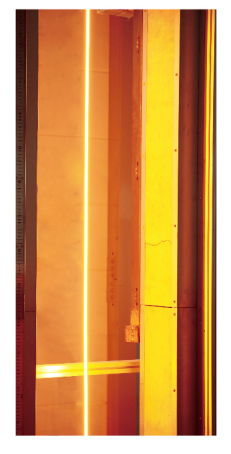
Below we give an example to illustrate how to set the control parameters of the temperature control instrument. For example: an electric furnace has 9 ¢6/12 heating elements, divided into three groups of three in each group, star-connected, and the working parameters of a single element are: 10V-150A-1500W, the transformer output loads the voltage of 35V on the three heating elements, the current is 180A, and the thyristor is adjusted (power regulator). The heating system and the control parameters of the temperature control meter are set as shown in the following table.
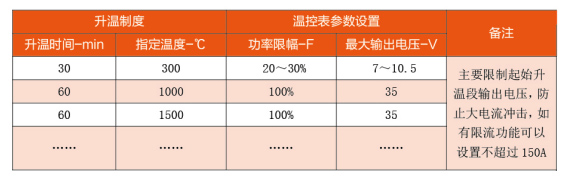
This setting can effectively prevent large current shocks in the initial heating stage, especially after the heating element has been used for a long time, the internal structure of the heating element will change, and the brittleness will increase. If the current shock is large, the heating element will brittlely break. This setting should be more cautious.
The resistance performance of molybdenum disilicide electric heating elements does not change with the increase of use time, so new and old elements can be mixed, which can greatly reduce the user's use cost.
3. High-temperature softening characteristics of molybdenum disilicide electric heating elements
In the low-temperature stage, molybdenum disilicide materials have high strength but high brittleness (similar to ceramics), and when the temperature reaches above 1000℃, it has metal-like soft plasticity. Since molybdenum disilicide electric heating elements are all operated at higher temperatures, we should consider the influence of their soft plasticity to avoid high-temperature deformation and damage to the elements.
For example, if the element is used horizontally, the use temperature should be reduced accordingly, because the higher the temperature, the greater the soft plasticity of the element, which will cause large deformation. The support of the plate should be considered, and the heat dissipation of the element should also be considered. L-shaped elements should consider that their gravity causes deformation, which may cause the elements to touch the furnace wall and be damaged, so special attention should be paid during the design and installation stage.
4. Protective film characteristics of molybdenum disilicide electric heating elements
The surface protective film of molybdenum disilicide electric heating elements is a layer of SiO2 glass film, which can prevent the internal MoSi2 matrix material from continuing to oxidize at high temperatures. This is the high-temperature anti-oxidation characteristic of molybdenum disilicide materials. However, due to the difference in expansion coefficients between the surface SiO2 glass film and the MoSi2 matrix material, when used in an intermittent oxidizing atmosphere electric furnace, the protective film will peel off due to the difference in expansion coefficients when cooling or heating. This is also the inherent characteristic of molybdenum disilicide electric heating elements. After the SiO2 glass film falls off, it will be used again in an oxidizing atmosphere, and the surface protective film will be generated again. This is the self-healing function of the protective film.

 Yantai Torch Special High Temperature Ceramics Co.,
Ltd
Yantai Torch Special High Temperature Ceramics Co.,
Ltd 0535-6891306 0535-6891305
  0535-6891307
 yttorch@torch-mosi.com
 www.torch-mosi.com
 No. 9 Xiulin Road, Laishan District, Yantai
City
No. 9 Xiulin Road, Laishan District, Yantai
City